You have got about two weeks of medication left. Your repeats are running out, your schedule is packed, and the thought of taking half a day off to sit in a waiting room for a ten-minute GP appointment feels genuinely impossible right now. If that sounds familiar, you are not alone.
For people managing ongoing mental health conditions, prescription renewals can become a recurring source of stress. Telehealth has changed that picture significantly, though it is not quite the frictionless workaround some people expect. Understanding how repeat scripts online actually work, and what is involved in a renewal, will help you plan ahead and avoid the anxiety of running out.
How telehealth changes the prescription process
Getting a repeat script online through telehealth is a genuine clinical consultation, not an administrative shortcut. Your prescriber still needs to review how you are going before they can issue a new prescription. What changes is the format: instead of travelling to a clinic, you connect via video call from wherever you are.
This matters because it removes most of the practical barriers that cause people to delay renewals, including the travel, the wait and the disruption to work. For ongoing, stable conditions, telehealth makes it far more realistic to stay on top of your medication without letting life get in the way.
How CareDirect supports the prescription process
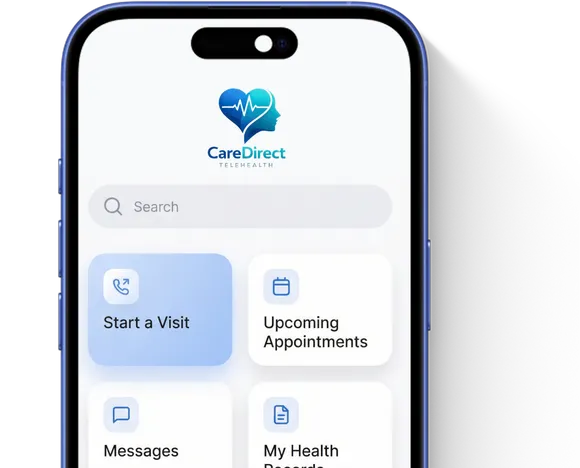
CareDirect is a mental health telehealth service that coordinates your care across multiple disciplines. While prescribing sits with your GP or treating medical practitioner, CareDirect’s mental health nursing team plays a key role in medication coordination.
Your journey begins with a complimentary nurse-led intake. The intake nurse takes a thorough health and medication history, works out what you need, and identifies the right combination of clinicians for your situation.
Between clinical sessions, the mental health nursing team handles ongoing coordination and case management. Your nurse monitors how you are going with medication, communicates with your GP about any concerns, and can facilitate a timely review before you run short. It is continuity of care rather than starting from scratch every time you need a script.
What is an eScript?
Once your GP or prescriber issues your prescription, you will typically receive it as an electronic prescription (eScript) rather than a paper document. The eScript arrives as a token via SMS, email or both. It contains a QR code your pharmacist scans to dispense your medication, with no paper or physical documents to collect.
eScripts carry exactly the same legal weight as paper prescriptions. You can take the token to any pharmacy, or have the prescription sent directly to one of your choice. Where a prescription includes repeat supplies held electronically, the token updates after each dispense, so your remaining repeats are always accessible without needing another consultation.
Medications that can typically be renewed via telehealth
Most standard medications prescribed for ongoing, stable mental health conditions can be renewed through a telehealth consultation with your GP where an established clinical relationship exists. This generally includes:
- SSRI and SNRI antidepressants for depression and anxiety conditions
- Mood stabilisers
- Certain antipsychotic medications
- Sleep and anxiety medications that are not controlled substances
In every case, your prescriber needs to conduct a genuine clinical review before renewing. That means checking in on how you are tolerating the medication, whether anything has changed, and whether the current dose still makes sense for you. It is not a formality, and it is often where useful adjustments get made.
Where additional steps may apply
Most renewals are straightforward. A small number of medication types involve extra regulatory requirements that are worth knowing about.
Schedule 8 medications
Schedule 8 (S8) medications are controlled substances subject to stricter rules across Australia. Stimulant medications commonly prescribed for ADHD fall into this category. The specific requirements vary by state and territory: some jurisdictions require an authority from the state health department, and some require at least one in-person clinical review per year.
This does not mean telehealth cannot play a role in your care. It means there may be one or two steps that happen differently compared to a standard renewal. Your GP or treating medical practitioner can advise you on what applies in your state, and CareDirect’s nursing team can coordinate with them accordingly.
First-time medication initiations
Starting a medication for the first time typically requires a more thorough assessment than a routine renewal. Telehealth supports this in many cases, though some medications involve baseline physical checks or monitoring that work best in person or with support from your GP.
When to request a renewal
Do not wait until the day you run out. As a general rule, contact your prescriber at least two weeks before your last repeat is due. That window allows time to schedule the consultation, complete any clinical review, issue the eScript and process it at the pharmacy, including any delays if a medication needs to be ordered in.
If your medication involves state authority renewals or has longer lead times, flag it with your CareDirect nurse early. Your nursing team can monitor your repeat cycle and prompt you before it becomes urgent.
If you have already run out, contact your GP or prescriber as soon as possible. For non-controlled medications, a short bridging supply may be possible. For S8 medications, options are more limited by regulation, which is why early contact matters.
Costs and PBS
At the pharmacy, PBS subsidies apply regardless of whether your prescription was issued via telehealth or in person. If your medication is PBS-listed and you hold a Medicare card, you pay the standard patient contribution. The telehealth component has no effect on your pharmacy costs.
For information about CareDirect consultation fees and Medicare rebates for mental health sessions, see the Medicare rebates guide.
Frequently asked questions
Can I get a repeat for my ADHD medication online?
It depends on the specific medication and your state or territory. Stimulant medications for ADHD are Schedule 8 controlled substances, which means they are subject to state-based authority requirements and, in some jurisdictions, mandatory in-person review. Your GP or treating medical practitioner can advise on what applies where you live. CareDirect’s nursing team can coordinate with your GP to support continuity of care.
How long does it take to receive an eScript?
In most cases, your eScript token is issued the same day as your consultation with your prescriber, often within a few hours. It arrives by SMS or email and can be taken to any pharmacy straight away. If your prescription requires state authority approval before it can be issued, allow additional time for that process to complete.
What if I have already run out of my medication?
Contact your GP or prescriber as soon as possible and explain that it is urgent. Depending on your medication and clinical history, an expedited review may be possible. For non-controlled medications, your GP may be able to provide a short bridging supply. For Schedule 8 medications, options are more limited by regulation, which is why reaching out early, before you run out, is important.
How does CareDirect help with medication management?
CareDirect’s mental health nurses coordinate medication monitoring as part of your overall care plan. They track how you are going, communicate relevant information to your GP, and help ensure renewals are organised before you run short. This coordination sits alongside your therapy, counselling and other clinical sessions.
Individual results vary based on your unique circumstances. Assessment findings do not guarantee a particular outcome.
Ready to get started?
If you need coordinated mental health support that works alongside your GP for medication management, CareDirect’s nurse-led model is designed for continuity and coordination. Start with a complimentary nurse-led intake to talk through your needs and find the right pathway.