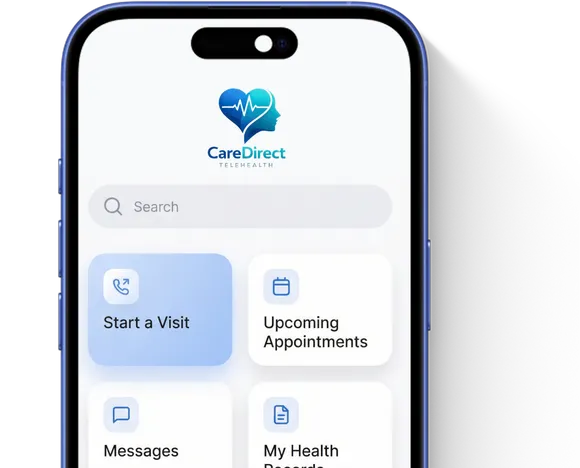
Most people searching “telehealth vs in person mental health” already have a hunch. They are leaning toward telehealth, it fits their life better, but they want to know if it actually works. For most presentations, the answer is yes. The evidence is consistent enough that “does telehealth work?” is no longer the useful question. The useful question is whether it works for your situation specifically.
That is what this article addresses.
What the evidence actually says
Research comparing telehealth and in-person mental health care has now been running for over a decade, across anxiety, depression, PTSD, adjustment difficulties and eating disorders. The consistent finding across studies published in peer-reviewed journals including the Australian and New Zealand Journal of Psychiatry is that evidence-based therapies, including CBT, ACT, schema therapy and EMDR-informed approaches, produce comparable outcomes when delivered via secure video versus in person. Symptom reduction, session attendance and therapeutic alliance ratings are all similar.
That does not mean the two are identical. Telehealth is a different delivery channel for the same clinical work, and it has genuine limits alongside its advantages. Collapsing everything into “they’re basically the same” does you a disservice. So does the reverse: suggesting telehealth is always inferior.
The clinically honest position is that telehealth works well for most people presenting with mild to moderate mental health concerns, and the access advantages it provides, fewer cancellations, no commute, continuity across location changes, have genuine clinical value. Missed sessions are one of the strongest predictors of poorer outcomes. Anything that makes it easier for you to show up consistently is, in that sense, therapeutic.
Where telehealth genuinely fits
Access is the obvious one. If you live more than an hour from a psychologist or psychiatrist who suits you, telehealth is not a compromise. It is the thing that makes consistent care possible at all.
But geography is not the only reason people do better on video. Consider whether any of these feel familiar:
- You have caring responsibilities, shift work or travel patterns that make fixed in-person appointments hard to keep.
- You find waiting rooms activating. For some people with anxiety or trauma histories, the clinical environment itself is a stressor before the session even begins.
- You have already built a relationship with a clinician and want to maintain that continuity through a move or circumstance change.
- You value the privacy of your own space. You process differently when you are at home. Some people open up more easily when they are not in an unfamiliar room.
- You have a chronic health condition, mobility consideration or sensory need that makes travel genuinely difficult.
In these circumstances, choosing telehealth is not settling. It is a sound clinical decision.
Where in-person care is genuinely better
There are situations where being in a room with your clinician matters, and it would be dishonest to minimise them.
If you are experiencing a severe or acute presentation, including active suicidal ideation, psychosis or a recent crisis, in-person or intensive support is usually the safer first step. The physical presence of a clinician allows for closer observation and immediate response in ways video cannot replicate.
Some trauma-focused protocols involve grounding and regulation work that relies on the clinician being physically present with you. The nuance of that work, the body language, the co-regulation, can be harder to establish through a screen.
Complex neuropsychological or diagnostic assessments often require in-person observation. Certain assessments for ADHD, autism spectrum conditions and acquired brain injury simply cannot be completed well via video.
If you do not have access to a private, stable, quiet space at home, video sessions can feel exposed or impossible to engage with fully. Your environment matters more than people expect.
If you are a young child or an adolescent who struggles with the format of video calls, in-person care may be a better fit, though this depends heavily on the individual and the clinician’s judgement.
None of this means telehealth is off the table if any of the above apply to you. It means the conversation is worth having carefully before you decide. That is exactly what our nurse-led intake is designed for.
Can you actually build a strong relationship with your therapist over video?
This is the question that matters most and gets asked least directly. The concern is understandable. If the therapeutic relationship is the mechanism of change, and research strongly suggests it is, then anything that compromises that relationship compromises your outcomes.
The evidence on therapeutic alliance in telehealth is reassuring. Studies consistently show that clients rate the quality of their working relationship with a telehealth clinician at levels comparable to those working face-to-face. What predicts a strong alliance is clinician fit, consistency and the structure of the work, not whether you are in the same room.
What video does ask of you is slightly different. You need a space where you can speak without being overheard. You need reliable internet and a device with a functioning camera. And you need to take the session as seriously as you would if you had driven somewhere for it. A short ritual at the start helps: close the door, silence your phone, make a drink. Give your brain a cue that this time is different from the rest of your day.
Those conditions in place, most people find they adjust to the format within a session or two and stop noticing the screen.
How to decide
A structured way to think through the question, without overcomplicating it.
-
What is the clinical picture? Mild to moderate anxiety, depression, trauma and grief responses are well supported in telehealth. More complex or acute presentations warrant a careful clinical conversation before choosing a format.
-
What does your life actually allow? A model of care that fits your schedule and your circumstances is better than a gold-standard one you keep missing. Think honestly about what you can sustain over three to six months, not just the first appointment.
-
Do you have a private, stable space at home? This is non-negotiable for video therapy to work. A parked car, a bedroom, a quiet home office all work. A shared open-plan living situation with housemates in earshot often does not.
-
Have you tried both? Some people genuinely do not know their preference until they experience both. A hybrid model, some sessions in person and some via video, is an option many clinicians are happy to support.
If you are still unsure after working through these, you do not need to figure it out alone. The nurse-led intake at CareDirect is a free 30-minute conversation with a mental health nurse whose job is to help you work through exactly this. No GP referral needed to begin.
Cost and Medicare rebates
One of the most persistent myths about telehealth is that it attracts a lower Medicare rebate. It does not. Where you are eligible, the same rebate basis applies to telehealth and in-person mental health sessions. Medicare treats the eligible telehealth item the same as its in-person equivalent. What telehealth removes is the indirect cost: travel, parking, time away from work.
A rebate may be available only where the practitioner type, referral, care plan and MBS item requirements are met. The exact amount depends on the current MBS rate and your eligibility, so confirm the current figure. For rebate eligibility details, see our Medicare rebates for mental health guide.
Our whole-person care model also explains how CareDirect integrates psychology, social work, occupational therapy, mental health nursing and dietetics into a coordinated plan, whether you access care via video or in person.
Frequently asked questions
Does telehealth therapy attract the same Medicare rebate as in-person?
Where you are eligible, yes. Telehealth mental health sessions with eligible clinicians may attract a Medicare rebate on the same basis as in-person sessions, where there is a current Mental Health Treatment Plan or other eligible referral and the MBS item requirements are met. The rebate is processed the same way. Your out-of-pocket cost is determined by the clinician’s fee and any rebate you are eligible for, not by the format.
Can I switch between telehealth and in-person if my circumstances change?
Usually, yes. Your Mental Health Treatment Plan belongs to you, and most referrals allow you to access eligible clinicians regardless of delivery format. If your situation changes, speak with your intake nurse or treating clinician about adjusting your care model. CareDirect is set up to support that flexibility.
How do I know if my clinician is qualified?
Every CareDirect psychologist, occupational therapist and mental health nurse is AHPRA-registered. Social workers are AASW-accredited and dietitians hold APD credential. Your nurse confirms credentials during the intake call and can answer questions about any clinician you are matched with.
What happens if my internet drops during a session?
It happens, and it is not a disaster. Your clinician will call you by phone and continue the session. Sessions are never cut short because of a technical issue.
Take the next step
If you are weighing up telehealth versus in-person care, the most useful thing you can do is have a proper conversation about it with someone who understands your situation. That is not something an article can replace.
CareDirect’s nurse-led intake is free, takes 30 minutes and requires no GP referral to access. A mental health nurse will take you through your history, your goals and your circumstances, then help you identify the right format, the right discipline and the right clinician for where you are now.
Book your intake and talk it through today.
Individual results vary based on your unique circumstances. Assessment findings do not guarantee a particular outcome.